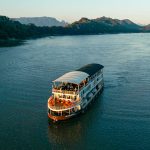
The Mekong River is woven deeply into the landscapes, history, culture, and everyday life of Laos. Flowing past forested mountains, Buddhist temples, farming communities, historic towns, and remote villages, the river offers travellers a perspective on the country that is difficult to experience from roads or trains. A Mekong cruise can be as simple as a sunset journey from Luang Prabang or as immersive as a multi-day voyage linking northern Laos with Vientiane or neighbouring Thailand. Today, travellers can choose between traditional slow boats and luxury Mekong River cruises available in Laos, depending on how much comfort and exploration they want. Operators such as Mekong Kingdoms River Cruises represent one premium approach, but the greater appeal comes from the river itself: the scenery, riverside culture, Buddhist heritage, and slower rhythm that make this part of Southeast Asia distinctive.
1. The Mekong Reveals Laos at a Slower Pace
One of the strongest reasons to cruise the Mekong is that river travel naturally encourages travellers to slow down. Instead of moving rapidly between attractions, passengers watch mountains, sandy banks, villages, temples, and fishing boats gradually appear and disappear from view.
Writing for National Geographic Traveller, Sarah Barrell describes how Laos “offers up its river like a wide, watery mirage — a sparkling passage through remote backcountry.”
That sense of gradual discovery separates a Mekong voyage from a conventional sightseeing itinerary. Travellers can spend mornings watching mist rise above forested hills, afternoons stopping at riverside communities, and evenings observing the water change colour as the sun sets.
The Independent similarly presents the slow boat between Thailand and Laos as a more serene way to travel, describing a journey through jungle scenery, cliffs, and small riverside settlements.
For visitors who normally travel according to tightly scheduled itineraries, this pace can become part of the attraction. The river itself provides much of the entertainment, making it possible to appreciate Laos without constantly rushing towards the next landmark.
2. Cruising Provides a Window Into Traditional Riverside Life
The Mekong is more than a scenic attraction. For generations, communities have depended on it for fishing, agriculture, transport, and trade, which means cruising provides glimpses of everyday life that travellers may otherwise miss.
Lonely Planet explains its historic importance simply: “For centuries, the Mekong was the country’s lifeblood.”
Along the river, travellers may see fishermen working from narrow boats, vegetable gardens cultivated on fertile banks, water buffalo cooling themselves near the shore, and villages where traditional crafts remain part of daily life.
Many cruises incorporate shore visits. Lonely Planet recommends boat trips from Luang Prabang to places such as the Pak Ou Caves as well as villages associated with pottery, mulberry-bark paper, and rice-whiskey production.
Longer itineraries can provide an even broader view of riverside culture. The six-day Luang Prabang–Vientiane itinerary operated by Mekong Kingdoms River Cruises, for example, currently includes activities such as traditional Saa paper making, pottery visits, village encounters, and a Baci blessing ceremony.
These excursions are most meaningful when they are approached respectfully. Travellers should view communities as living places rather than staged attractions, asking permission before photographing people and following guidance from local hosts.
3. Temples, Caves and Historic Towns Add Cultural Depth
A Mekong cruise through Laos is also a journey through the country’s Buddhist and historical heritage. Luang Prabang, one of the main starting points for river journeys, is a UNESCO World Heritage city known for monasteries, temple roofs, traditional Lao buildings, and colonial-era architecture.
Condé Nast Traveller notes that Laos is shaped by the Mekong and describes the river as “an artery of communication, a source of food, a dispenser of fortune and disaster.”
One of the best-known river excursions from Luang Prabang leads to the Pak Ou Caves, where thousands of Buddha figures have been placed within limestone caverns overlooking the Mekong. Travel advisor Jack Tydeman, writing for Travel + Leisure, highlights the caves as a pilgrimage site that remains important for local Buddhist worship.
The cultural experience also changes along longer routes. Journeys travelling south from Luang Prabang encounter increasingly remote landscapes before eventually reaching the wider surroundings of Vientiane.
This ability to connect cities, sacred locations, villages, and natural scenery makes river travel particularly rewarding. Instead of experiencing Lao culture as separate museum visits and excursions, travellers can begin to understand how settlements and traditions developed around the waterway.
4. Modern Cruises Combine Local Character With Greater Comfort
Traditional slow boats remain an important way to experience the Mekong, but travellers who want more comfort now have several premium options. These can include private cabins, onboard dining, lounges, spa treatments, guided excursions, and smaller passenger numbers.
National Geographic Traveller describes one modern vessel as delivering a “brilliantly balanced mix of local character and international comforts.”
This reflects the changing range of luxury Mekong River cruises available in Laos. Travellers who might once have considered the river mainly as adventurous transport can now experience multi-day voyages without giving up comfortable accommodation and attentive service.
Mekong Kingdoms River Cruises currently operates both day and overnight journeys. Its Bohème vessel has 13 cabins for up to 26 passengers, while the smaller Gypsy carries up to four guests. Current routes include journeys between Luang Prabang and Vientiane as well as cross-border voyages connecting Luang Prabang with the Golden Triangle.
Travel + Leisure also highlighted the expansion of upper-Mekong cruising, noting the launch of Bohème and other small luxury vessels designed to explore Laos in greater comfort.
The right choice depends on the traveller. Some visitors may prefer the simplicity and social atmosphere of a traditional slow boat, while others may value ensuite cabins, organised excursions, fine dining, and smaller group sizes.
5. Seasonal Changes Give the River Different Personalities
Another factor that makes Mekong cruising interesting is how dramatically the river and surrounding landscape can change with the seasons. Water levels, vegetation, temperature, and navigation conditions all affect the experience.
Travel + Leisure travel advisor Jack Tydeman writes that “Laos retains a timeless feel.”
That timeless atmosphere can appear very different depending on when travellers arrive. The cooler, drier months are popular for comfortable sightseeing, while the wetter green season transforms surrounding vegetation into a particularly lush landscape.
Mekong Kingdoms currently identifies November to February as a popular period because of the pleasant weather, while noting that the June-to-October green season brings greener scenery and different navigation conditions.
Travellers should therefore consider more than air temperature when planning. River levels, rainfall, the particular itinerary being operated, and the type of scenery they want to experience can all influence the best travel period.
A good cruise operator should also explain how seasonal conditions might change stops or navigation before passengers book.
Conclusion
Cruising the Mekong in Laos provides something that faster forms of travel cannot easily reproduce: the opportunity to watch the country’s landscapes and communities unfold gradually from the water. Forested mountains, Buddhist sites, traditional villages, working riverbanks, and historic cities are all connected by the same waterway, helping travellers understand why the Mekong has played such an important role in Lao life.
Visitors can choose simple day cruises, traditional slow boats, or the growing selection of luxury Mekong River cruises available in Laos. Companies such as Mekong Kingdoms River Cruises provide one premium option, with small-ship voyages linking Luang Prabang, Vientiane, and the Golden Triangle, but luxury is only one way to experience the region.
Ultimately, what makes the Mekong special is not the vessel but the perspective the river provides. Travelling slowly allows visitors to see landscapes change, observe daily life along the banks, discover sacred sites, and appreciate a side of Laos that is best understood from the water.